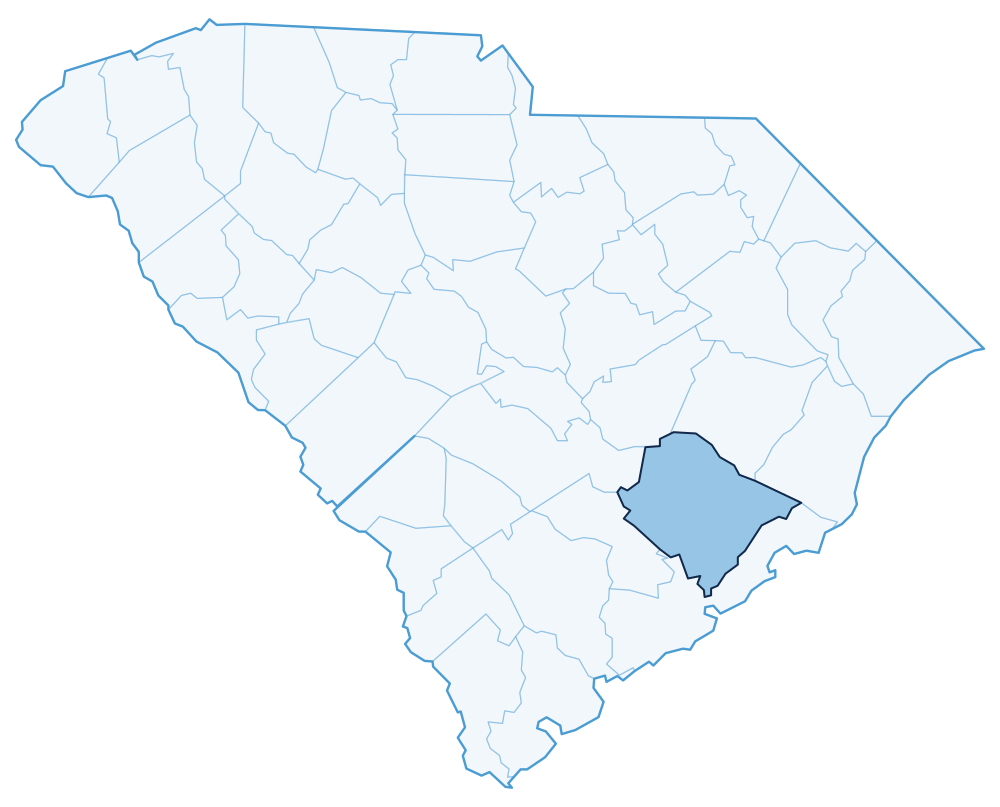
Berkeley County
86 places on the trail: 86 highway markers.
Colonial (pre-contact to 1763)
- 08-00Barnet's TavernNear this spot stood Barnet’s Tavern, called the Forty-Five Mile House, indicating its distance from Charleston. Here wa...
- 08-45Boochawee HallBoochawee Hall, created in 1683 by a 2,400-acre grant, was owned by two colonial governors, father and son. James Moore ...
- 08-55Broom Hall PlantationBroom Hall Plantation, later called Bloom Hall and still later Bloomfield, was first granted to Edward Middleton in 1678...
- 08-46Button HallThis plantation was once part of Boochawee Hall, owned by Governor James Moore (d. 1706). Moore left 615 acres to his da...
- 08-69Carnes CrossroadsCarnes Crossroads was part of a 3,000 acre royal grant to Joseph Thorowgood in 1682. Later, the Etiwan, Native Americans...
- 08-24Cherokee PathThe main Cherokee Path, which extended from the overhill towns of the Cherokee Indians in present Tennessee to Charlesto...
- 08-56Crowfield PlantationCrowfield Plantation, on the headwaters of Goose Creek, was originally granted to John Berringer in 1701. John Gibbes (1...
- 08-57Early Indian Trading PathsOne of the earliest major trading paths in the Carolina colony, dating from the first decade of English settlement 1670-...
- 08-71Eighteen Mile House TavernFrom the 18th century, the State Road from Charleston and the Road to Dorchester met near here. These paths connected Ch...
- 08-84Etiwan IslandPrior to European settlement this island was inhabited by the Etiwan Indians. Archaeological excavations in nearby area ...
- 08-86Etiwan VillageIn this area is the site of an Etiwan Indian village. The earliest record of the Etiwan tribe is a 1609 report from a Sp...
- 08-63French Huguenot PlantationAbraham Fleury, sometimes called Abraham Fleury Sieur De La Plaine, settled here about 1680. He was one of the first Fre...
- 08-50Goose CreekThis area has been called Goose Creek since the late 17th century. For almost 200 years after the Lords Proprietors gran...
- 08-59Goose Creek BridgeThe first bridge here, in use by 1680, had a raised road at either end and was built from split logs with the flat sides...
- 08-06Goose Creek ChurchThe Parish St. James was founded by Act of Assembly in 1706. The present edifice was begun in 1714, and completed in 171...
- 08-41Howe Hall PlantationHowe Hall Plantation, an inland rice plantation, was established here by Robert Howe, who came to S.C. in 1683. His firs...
- 08-42Howe Hall PlantationHowe Hall Plantation was established here by Robert Howe about 1683 and passed to his son Job Howe (d. 1706), Speaker of...
- 08-44Liberty Hall PlantationThis inland rice plantation has its origins in a 1683 grant. In 1726 Nathaniel Moore and his wife sold a 900-acre parcel...
- 08-80Martin's TavernNear here stood Martin’s Tavern, also known as the Forty-Five Mile House for its distance from Charleston. On Sept. 11, ...
- 08-19MedwayMedway, established in 1686, features a 1704-05 brick house which is one of the oldest in S.C. The Lords Proprietors gav...
- 08-04Mulberry PlantationOriginally granted to Sir Peter Colleton in 1679. Acquired in 1712 by Thomas Broughton, who erected the present mansion,...
- 08-85Nisbett HouseThis two-story wood frame building was built c.1725 for Alexander Nisbett of Dean, Scotland. It was originally the main ...
- 08-17Old JamestownAfter receiving a proprietary land grant of 370 acres in 1705, French settlers laid out the town of Jamestown, c. 2 mi. ...
- 08-02Old Moncks CornerHere was located the provincial town of Moncks Corner, deriving its name from Thomas Monck, an Englishman, who in 1735 p...
- 08-29Otranto Indigo VatBuilt 1750-1790 at Otranto Plantation and used to process dye from indigo, an important S.C. crop from 1747 to 1796. Mov...
- 08-11Pompion Hill ChapelOne quarter mile north, the first Church of England edifice outside Charleston was erected of cypress in 1703, largely t...
- 08-76Quintyne PlantationRichard Quintyne (d.1695) established a plantation near here and a creek .5 miles east in the 1680s. Likely born in Engl...
- 08-21Silk Hope PlantationHome and burial place of Sir Nathaniel Johnson, born in the County of Durham, England, in 1644; knighted in 1680, was a ...
- 08-60Spring Grove PlantationSpring Grove, an inland rice plantation on the Back River, was part of a 1706 grant by the Lords Proprietors to John Bar...
- 08-40Springfield PlantationSpringfield Plantation, an inland rice plantation, was established here by Paul Mazyck (d. 1749), a planter and merchant...
- 08-47St. James, Goose CreekSt. James, Goose Creek was one of the first Anglican parishes in the lowcountry, created by the Church Act of 1706. The ...
- 08-48St. James, Goose Creek Chapel of EaseOne of two chapels of ease for St. James, Goose Creek Parish stood here on the road to Moncks Corner, about 7 miles from...
- 08-13St. Thomas ChurchThe Parish of St. Thomas was established by Act of Assembly Nov. 30, 1706. The first church was erected in 1708 and dest...
- 08-20Strawberry ChapelChapel of Ease to St. John's (Biggin Church), built about 1725 on land bequeathed by James Child, founder at this place,...
- 08-54The OaksThe Oaks, an inland rice plantation, was established here by Edward Middleton (d. 1685) on a 1678 grant from the Lords P...
- 08-61The Yamasee War at Goose Creek, 1715In April 1715 Yamasee warriors killed government agents and traders who had come to meet with them at Pocotaligo, in pre...
- 08-49Thorgood PlantationIn 1682 the Lords Proprietors granted 3,000 acres here, on a branch of the Back River, to Joseph Thorogood (d. 1684). Th...
- 08-23Wadboo BaronyNear this point was the SW corner of Wadboo Barony, a 12,000 acre tract about 4 miles square, granted in 1683 to James C...
- 08-62WassamassawWassamassaw, with several variant spellings during the colonial era, is a Native American word thought to mean “connecti...
Era of American Revolution (1764-1783)
- 08-07Battle of Lenud's FerryHere, on May 6, 1780, Col. A. M. White was routed by Tarleton with the loss of 2 officers and 36 men killed and wounded ...
- 08-12Brabant PlantationResidence of Rt. Rev. Robert Smith, who was born in Norfolk England, 1732. He was consecrated in Philadelphia in 1795 as...
- 08-68Fairlawn PlantationFairlawn Barony, sometimes called “Fair-Lawn,” was granted to Peter Colleton, whose father John had been one of the orig...
- 08-18Francis MarionBrigadier General of S.C. Militia during the American Revolution, Francis Marion, was one of the partisan leaders who ke...
- 08-25Francis MarionAccording to family information, Francis Marion, brigadier general of the S.C. Militia during the American Revolution, w...
- 08-16Lewisfield PlantationThis land, part of Fairlawn Barony and known as Little Landing, was bought in 1767 by Sedgwick Lewis. His daughter Sarah...
- 08-83Maham PlantationNorth of here was a plantation owned by Hezekiah Maham (1739-1789). A legislator, soldier, and planter, Maham owned 500 ...
- 08-08Mepkin PlantationHome of Henry Laurens, who was born in Charleston in 1724 and died at Mepkin in 1792. President of the first and second ...
- 08-10Quenby BridgeAt this bridge, on July 17, 1781, British forces under Col. Coates, who was retreating from Moncks Corner, encountered p...
- 08-88Skirmish at Tidyman's PlantationOn Feb. 25, 1782 Patriot Gen. Francis Marion resumed his command at nearby Tidyman’s Plantation (Cedar Hill) after servi...
- 08-32Skirmish at Wambaw BridgeOn February 24, 1782, at Wambaw Bridge 6 mi. N, a force of British cavalry, regular infantry, and Loyalist militia under...
- 08-87Skirmish at Wambaw BridgeOn Feb. 24 1782 a Revolutionary War skirmish took place at a bridge over nearby Wambaw Creek. Early that morning, Col. B...
- 08-90Skirmish at Wells's PlantationDuring the night of Aug. 24, 1781, a Revolutionary War skirmish took place at Wells’s Plantation on Bull Head, a portion...
- 08-34St. Stephen's Episcopal ChurchSt. Stephen’s, built 1767-69, is a fine example of the rural churches built in the S.C. lowcountry before the Revolution...
- 08-15Thomas Sumter's StoreAbout 1765-1767 Thomas Sumter, future hero of the American Revolution, kept a country store near this spot where the str...
- 08-81Thomas Sumter's StoreThomas Sumter, influential militia leader in the American Revolution, kept a store in this area about 1765-1767. Born in...
- 08-30Thomas WalterThe grave of Thomas Walter (c. 1740-1789), pioneer botanist, is 9 mi. W at his Santee River plantation. A native of Engl...
- 08-91Wambaw PlantationBall and Henry Laurens in 1756. Later a major S.C. political leader, Laurens’s stake in Wambaw first qualified him for l...
South Carolina in the Early Republic (1784-1815)
- 08-09Biggin Church RuinsThese ruins are all that remains of Biggin Church, built soon after the American Revolution as the parish church of St. ...
- 08-03Santee CanalThis canal, twenty-two miles in length, connects the Santee and Cooper Rivers. The canal was chartered in 1786, and cons...
- 08-36Santee Canal {Marker #2}This canal, twenty-two miles in length, connects the Santee and Cooper Rivers. It was chartered by act of March 22, 1786...
- 08-52The Village of PinevillePineville, established in 1793-94, was one of the first planters’ retreats in the South. James Sinkler built the first s...
Antebellum (1816-1860)
- 08-58Bowen's CornerBowen’s Corner, an African-American farming community from the mid-19th century through the late-20th century, was origi...
- 08-67Friendship Methodist ChurchThis church, one of the oldest Methodist organizations in Berkeley County, was formally organized about 1825. Circuit ri...
- 08-53Mount Holly StationMount Holly Station, a depot on the Northeastern Railroad between Florence and Charleston, was built here about 1853. It...
- 08-31PinopolisPlantation owners began this pineland village in the 1830s to escape lowcountry plantation summer nights, thought to cau...
- 08-35Rehoboth Methodist ChurchThis church grew out of services held as early as 1811, at first in a brush arbor and later at a campground nearby. Mini...
- 08-14Spring Hill Methodist ChurchAccording to tradition Methodists worshiped here under a brush arbor as early as 1800. On August 2, 1814, Phillip Keller...
- 08-28St. John's ChurchThis Baptist Church, constituted 1851, constructed the present building here in 1881 on land donated by A. D. Hare, a ch...
Civil War (1861-1865)
Reconstruction (1866-1876)
New South (1877-1913)
- 08-70Cherry Hill ClassroomThis school was built ca. 1876 on land donated by John Campbell for a building that would serve as both a school for Afr...
- 08-26Cross Post OfficeThis post office, originally named Cross Mill, was established in 1879. Adam Cross, a local storekeeper and Civil War ve...
- 08-73New Hope Methodist ChurchThe congregation of New Hope Methodist Church dates to 1837. At that time the congregation consisted of both white membe...
World War I and the Interwar Period (1913-1941)
- 08-89Berkeley County HospitalAround 1930, Anne Sinkler Fishburne and Dr. Kershaw Fishburne led a campaign by the Berkeley Tuberculosis Association to...
- 08-75Cordesville Rosenwald SchoolCordesville Rosenwald School, the first African American public school in Cordesville, S.C., was built on this site in 1...
- 08-78Keith SchoolThis was the site of a public school for African Americna families in this section of lower Berkeley Co. It was housed i...
- 08-37L. Mendel Rivers HouseLucius Mendel Rivers (1905-1970), lawyer, state representative 1933-36 and U.S. Representative 1940-70, was born in near...
- 08-77Laurel Hill SchoolThis is the last site of Laurel Hill School, which served African American families mainly from the community of Alvin. ...
- 08-82Oakley SchoolThis was the site of a public school for African American residents of the Oakley community, originally known as Oakley ...
- 08-74St. Stephen (White) High SchoolSt. Stephen High School was the first public white H.S. for the town of St. Stephen. The current building was built 1928...
- 08-51St. Stephen Colored SchoolSt. Stephen Colored School, the first public African American school in St. Stephen, was built here in 1924-25. A three-...
- 08-43Varner Town Indian CommunityVarner Town (or Varnertown) is a distinct Native American community including descendants of the Etiwan, Catawba, Cherok...
World War II and After (1941-present)
- 08-66Berkeley Training High SchoolBerkeley Training High School, located here from 1955 to 1970, replaced a four-room wood school 1 mi. S at Main St. and ...
- 08-39Dixie Training SchoolBerkeley Training High School, first called Dixie Training School, stood here from 1920 until the 1980s. The first publi...
- 08-72Maude E. Callen ClinicMaude E. Callen (1898-1990) was born in Quincy, FL. She received formal training at Florida A&M Univ. and the Tuskeegee ...
- 08-79S.C.O.P.E. Freedom HouseIn 1965, this was the Berkeley County headquarters of Summer Community Organization and Political Education (SCOPE), a v...