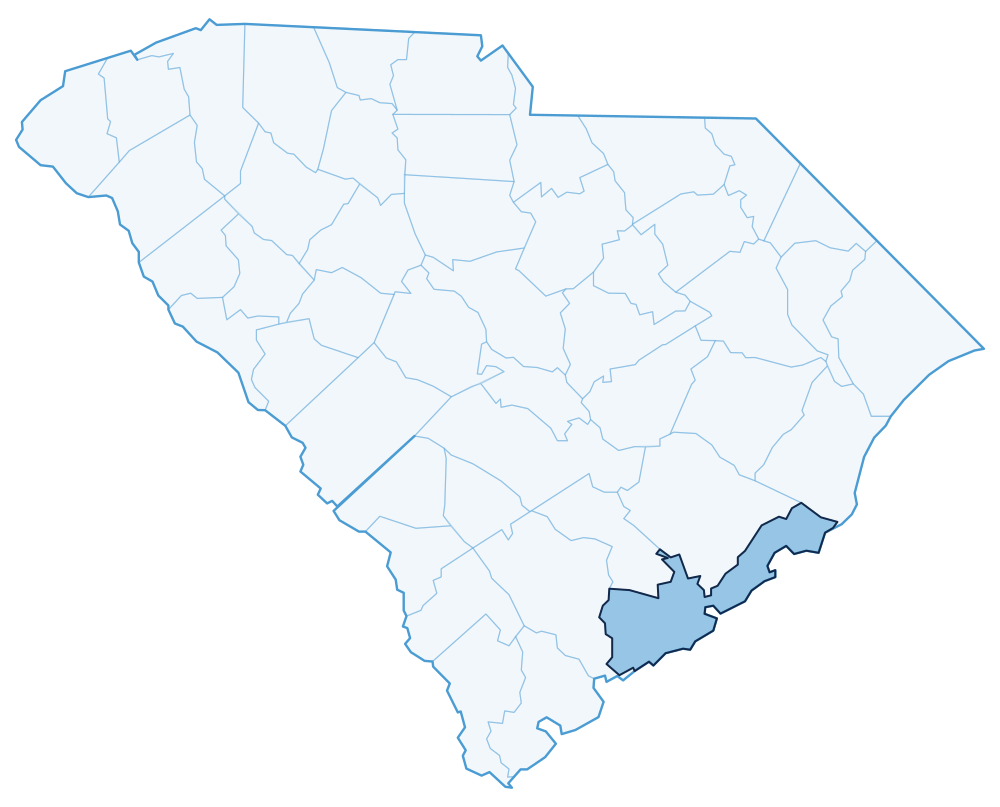
Charleston County
169 places on the trail: 158 highway markers, 11 battlefields and state sites.
People of Charleston County in Carolina Quotes
Albert MackeyBorn in CharlestonCharles Cotesworth PinckneyBorn in CharlestonDuBose HeywardBorn in CharlestonEdward RutledgeBorn in CharlestonFrank Lebby StantonBorn in CharlestonHenry TimrodBorn in CharlestonJames Matthews LegaréBorn in CharlestonJon PinedaBorn in CharlestonJosephine PinckneyBorn in CharlestonJulia C. R. DorrBorn in CharlestonMo BrooksBorn in CharlestonNancy MaceLived in CharlestonRobert JordanBorn in CharlestonSallie KrawcheckBorn in CharlestonSarah GrimkéBorn in CharlestonScott BessentLived in CharlestonWashington AllstonBorn in CharlestonWilliam Gilmore SimmsBorn in Charleston
Colonial (pre-contact to 1763)
- 10-31Boone Hall PlantationBoone Hall Plantation, established in 1681 by a grant to Major John Boone, remained in the family for 130 years. The pla...
- 10-84Charles TowneThe first permanent English settlement in what is now S.C. was established here in 1670. Named for King Charles II, the ...
- 10-07Christ ChurchThe Church Act of 1706 created Christ Church Parish. The first church, a wooden structure built in 1707, accidentally bu...
- 10-74Cook's Old Field CemeteryThis plantation cemetery predates the American Revolution. It was established by early members of the Hamlin, Hibben and...
- 10-14Drayton HallSeat of the Drayton family for seven generations, this land was acquired in 1738 by John Drayton (c. 1715-1779) as the c...
- 10-157Fenwick Indigo VatsOn this site are the rare surviving remnants of four 18th century indigo vats. Indigo is a blue dye derived from several...
- 10-119Fenwick PlantationFenwick Plantation began as a 3,000-acre tract purchased in 1721 by John Fenwick, an English planter. Fenwick had the tw...
- 10-129Hampstead VillageThis site was the center of Hampstead Village, a suburb of Charleston laid out for Henry Laurens in 1769. The village’s ...
- 10-40Hampton PlantationHampton Plantation, 2 mi. NW, was established by 1730 and was one of the earliest rice plantations on the Santee River, ...
- 10-137Huguenot ChurchFrench Protestants known as Huguenots were among the earliest Europeans to arrive in colonial S.C. They were part of a b...
- 10-75Inland Rice Fields, ca. 1701-1865Embankments and ditches dating from the early 18th century are still visible here and show the elaborate layout of rice ...
- 10-02John's Island Presbyterian ChurchFounded by early English, Scottish, and French settlers about 1710, this is one of the oldest Presbyterian congregations...
- 10-139K.K. Beth ElohimJews were present in Carolina by the 1690s. By 1820, Charleston had the largest Jewish population in the U.S. Kahal Kado...
- 10-18Laurel Hill PlantationJohn Boone owned this land by 1694, and the plantation that developed here passed in 1864 to Dr. Peter P. Bonneau, signe...
- 10-52Maybank GreenIn 1697 David Maybank II (1660-1713) acquired 200 acres along Hobcaw Creek from the Lords Proprietors. Maybank, a carpen...
- 10-29Old Wappetaw ChurchCongregationalists from New England built a church near here around 1700. Troops from both sides camped on the grounds d...
- 08-27Otranto PlantationOriginally known as "Yeshoe," this plantation was granted in 1679 to Arthur Middleton, great-granduncle of the signer of...
- 10-105Pinckney MansionThe Pinckney Mansion was a Colonial double house built c.1746 at this site, then a large waterfront lot known as Colleto...
- 10-73Plainsfield PlantationPlainsfield Plantation, on this site, and Pawletts Plantation, nearby, were established ca. 1690 by Joseph Blake (1663-1...
- 10-158Saint James Episcopal ChurchSaint James Church began in 1720 as a chapel of ease serving the James Island section of St. Andrews Anglican Parish. Re...
- 10-00St. Andrew's Parish ChurchBuilt in part in 1706, the year the Church of England was established here by law. Enlarged 1723. Burned out and rebuilt...
- 10-123St. Andrew's Parish ChurchSt. Andrew’s Parish Church was one of ten Anglican churches established in S.C. by the Church Act of 1706. The church wa...
- 10-26St. James Santee Parish ChurchErected in 1768, this edifice, officially known as Wambaw Church, was situated on the King's Highway. It is the fourth c...
- 10-134St. John's Episcopal ChurchThe parish of St. John’s, Colleton was created by the S.C. legislature in 1734. It included Johns, Edisto, Wadmalaw, Kia...
- 10-120St. Paul's Parish ChurchThis is the second site of St. Paul’s Parish Church, erected here in 1736 as a chapel of ease for the first parish churc...
- 10-36St. Paul's StonoSt. Paul’s Parish, one of the ten original parishes of colonial S.C., was created by the Church Act of 1706. The first p...
- 08-65Steepbrook PlantationThis plantation was established in 1701 by a grant of 500 acres near Goose Creek to Lewis Lansac from the Lords Propriet...
- 10-15The Grand Lodge of Ancient Freemasons of South Carolina ANCIENT FREEMASONS The Grand Lodge of Ancient Freemasons of South CarolinaOrganized before August 18, 1737, this Grand Lodge met in Charles Shepheard's Tavern, an early meeting place of the colo...
- 10-48The Stono RebellionThe Stono Rebellion, the largest slave insurrection in British North America, began nearby on September 9, 1739. About 2...
- 10-03Thomas SmithGovernor of Carolina, /1693-1694/Planter, Merchant, Surgeon,/arrived in Charles Town in 1684 with his first wife, Barbar...
- 08-64White House PlantationThe first plantation here was established in 1731 by Alexander Vanderdussen (d. 1759), British army officer and member o...
Era of American Revolution (1764-1783)
- 10-93Battle of Dills BluffThe Battle of Dills Bluff, the last engagement in S.C. during the American Revolution, took place on Nov. 14, 1782. Cont...
- 10-46Battle of Fort SullivanOn June 28, 1776, a British and Loyalist force seeking to capture Charleston advanced to Sullivan's Island with 9 ships ...
- 10-146British Evacuation of CharlestonOn Dec. 14, 1782, the last remaining British soldiers in the Carolinas evacuated Charleston from this site. Their depart...
- 10-156British FortificationsOn this site are remnants of a British fortification dating to the American Revolution. After departing in 1775, the Bri...
- 10-09Chamber of CommerceOn December 9, 1773, the first Chamber of Commerce in the City of Charleston was organized on Broad Street at Mrs. Swall...
- 10-112College of CharlestonFounded in 1770 and chartered in 1785, the College of Charleston is the oldest college in S.C. and is among the oldest i...
- 10-133Gibbes LandingAt the mouth of this tidal creek is the colonial-era site of Gibbes Landing. Located on a low bluff off the Ashley River...
- 10-11Lord CornwallisMajor General Charles Cornwallis established a brigade headquarters not far from this site on or around June 19, 1776. H...
- 10-124Skirmish at St. Andrew's Parish ChurchOn March 22, 1780, British and Hessian troops nearing Charleston were met by Patriot cannon fire near St. Andrew’s Paris...
- 10-60The ElmsThe Elms, an inland rice plantation on the headwaters of Goose Creek, was owned by the Izard family for more than 150 ye...
- 10-17The Elms PlantationRalph Izard inherited The Elms after his father's death in 1749. During the Revolution he provided financial support to ...
- 10-65The Siege of Charleston, 1780The British capture of Charleston in May 1780 was one of the worst American defeats of the Revolution. On March 30-31 Ge...
South Carolina in the Early Republic (1784-1815)
- 10-54French Botanical GardenAndré Michaux (1746-1802), botanist to Louis XVI of France, lived here 1786-96. He established a botanical garden 300 ya...
- 10-21Grave of Colonel William A. Washington3/4 mile on Live Oak Plantation at Sandy Hill Plantation, seven miles N.W, this Virginian made his home in the country t...
- 10-30Jacob Bond I'on (1782-1859)Jacob Bond I'On (1782-1859), planter, U.S. Army and militia officer, and state legislator, is buried in the family cemet...
- 10-12John Rutledge HomeThis house, built before the American Revolution, was the residence of John Rutledge (1739-1800), first Governor of the ...
- 10-72Old Bethel Methodist ChurchThis church, built in 1797 in the meeting-house form, was dedicated in 1798 and completed in 1809. It is the oldest Meth...
- 10-55Point PlantationThe McClellan family for which McClellanville was named acquired this land shortly before the American Revolution. A 490...
- 10-20Snee FarmThe country home of Charles Pinckney (1757-1824), Snee Farm stands about 0.7 mi. west of here. One of SC's signers of th...
- 10-05St. Michael's ChurchHere in the churchyard of/St. Michael's lie buried/two Signers of the/U. S. Constitution/CHARLES COTESWORTH/PINCKNEY/(17...
- 10-06St. Philip's ChurchHere in the churchyard of St. Philip's are buried/CHARLES PINCKNEY/(1757-1824)/Signer of the United States Constitution ...
- 10-19Thomas Pinckney 1750-1828Distinguished planter-diplomat Thomas Pinckney owned nearby Fairfield and Eldorado plantations. A national figure, he wa...
- 10-10War of 1812 EncampmentOn June 18, 1812, the United States declared war against Great Britain. One of the first units to be mustered into servi...
Antebellum (1816-1860)
- 10-89Blake-Grimké HouseThis Charleston double house was built before 1789 by William Blake, a planter and descendant of former Proprietary Gove...
- 10-66Calvary Episcopal ChurchThis church, located on Beaufain Street for 91 years, was organized in 1847 to give free blacks and slaves in antebellum...
- 10-94Charleston Public Water SystemIn 1823, after learning of London’s success with artesian wells, City Council agreed that deep artesian wells would be f...
- 10-145Edisto Island Baptist ChurchThis wood frame church was built in 1818 as Edisto Island Baptist Church. The church was founded primarily through the e...
- 10-92Fireproof BuildingConstructed 1822-26, the County Records Building, known as the Fireproof Building, was designed by Charleston-born archi...
- 10-70Hampstead CemeteryA cemetery established here in 1841, also known as “God’s Acre” and later “the German Cemetery,” was maintained by St. M...
- 10-53Magnolia CemeteryMagnolia Cemetery, established in 1850, was named for Magnolia Umbra Plantation, dating back to 1784. The ca. 1800 house...
- 10-24McClellanvilleMcClellanville began in the late 1850s and early 1860s when local plantation owners A. J. McClellan and R. T. Morrison s...
- 10-106Memminger HouseChristopher Memminger (1803-1888) lived in a home at this site as early as 1830. A German immigrant orphaned at age 4, M...
- 10-45Mills House HotelThe original Mills House Hotel, later the St. John Hotel, stood on this site for 115 years. Built in 1853 for Otis Mills...
- 10-25Mount Pleasant Presbyterian ChurchErected about 1854 and originally a Congregational Church affiliated with Old Wappetaw Church, founded about 1699. Serve...
- 10-04Old Bank BuildingConstruction having begun in 1797, this building was occupied by the Bank of South Carolina on December 10, 1798, making...
- 10-91Slave AuctionsCharleston was one of the largest slave trading cities in the U.S. In the 1800s, the area around the Old Exchange Buildi...
- 10-126Slave Trading ComplexThis was the south end of a large slave trading complex known as The Mart or Ryan’s Mart. It was opened in 1856 by Thoma...
- 10-127Slave Trading ComplexFrom 1856 to 1863, this was the north end of a slave trading complex known as The Mart or Ryan’s Mart. It was opened by ...
- 10-01South Carolina Canal & Rail Road Company Original Track Location in CharlestonBegan its first successful scheduled steam railroad service in America on December 25, 1830, and by 1833 its 136 miles f...
- 10-22St. John's ChurchThis church grew from services held for German inhabitants in Charleston by Rev. Johann Martin Boltzius in 1734 and Rev....
- 10-08Trinity Methodist Church Original SiteThe first Trinity Church building was erected on this site in 1792. By 1813, Trinity had joined the S. C. Conference, an...
- 10-118Weston-Grimké HomesiteArchibald (1849-1930) and Francis Grimké (1850-1937), early 20th century activists for African American rights, grew up ...
Civil War (1861-1865)
- 10-59Battery ChevesThis four-gun Confederate artillery battery was one of several earthworks built on the southeastern shore of James Islan...
- 10-51Battery HaigThis Confederate earthwork, named for the owner on whose plantation it was built, was constructed in 1863. It and other ...
- 10-58Battery HaskellThis two-gun Confederate artillery battery and magazine is all that remains of Battery Haskell, a large fortification bu...
- 10-56Battery Number 5This was one of several Confederate earthworks constructed on the southwest portion of James Island in the summer of 186...
- 10-27CS H. L. HunleyThe CS H.L. Hunley, the first submarine to sink an enemy warship, left from a point near here on the evening of February...
- 10-64Camp of Wild's "African Brigade," 1863-1864Folly Island was occupied by Union troops April 1863-February 1865. Gen. Edward A. Wild’s “African Brigade” camped nearb...
- 10-39Confederate LinesThe earthworks nearby are remains of the 1861 fortifications built to defend Mount Pleasant. They extended east 2.5 mile...
- 10-50Federal Expedition on John's IslandThe Battle of Burden’s Causeway was the climax of a Federal expedition against John’s Island, July 2-9, 1864. 5000 Feder...
- 10-99First Memorial DayHampton Park was once home to the Washington Race Course and Jockey Club. In 1864 this site became an outdoor prison for...
- 10-62Fort PembertonFort Pemberton, a large five-sided Confederate earthwork on the James Island side of the Stono River, was built in the s...
- 10-69Institute HallInstitute Hall, built here in 1854, stood until 1861. An Italianate building, it was designed by Jones and Lee for the S...
- 10-61Redoubt Number 3Redoubt Number 3, built here in 1861-62, was one of six identical Confederate earthworks built across the center of Jame...
- 10-34RiversvilleRiversville, an antebellum village of fourteen acres, with seven lots on Savannah (later Secessionville) Creek, was esta...
- 10-138Skirmish at Grimball's PlantationOn June 10, 1862 a Civil War skirmish occurred near this site. Union forces had recently set up camp at Thomas Grimball’...
- 10-76The Seizure of the PlanterEarly on May 13, 1862, Robert Smalls, an enslaved harbor pilot aboard the Planter, seized the 149-ft. Confederate transp...
Reconstruction (1866-1876)
- 10-132Beefield CommunityBeefield is one of a number of James Island communities founded after the Civil War by formerly enslaved African America...
- 10-100Constitutional Convention of 1868In January 1868 delegates met to rewrite the S.C. Constitution. They convened at the Charleston Club House, which once s...
- 10-152Ebenezer A.M.E. ChurchEbenezer African Methodist Episcopal (A.M.E.) is the oldest church congregation in the Town of Lincolnville. In 1874 tru...
- 10-37Laing SchoolLaing School, located here from 1868 to 1953, was founded in 1866 by Cornelia Hancock, a Quaker who had served as a nurs...
- 10-41Liberty HillLiberty Hill, established in 1871, is the oldest community in what is now North Charleston. In 1864 Paul and Harriet Tre...
- 10-103LincolnvilleThe Town of Lincolnville was founded in 1867 by seven African American leaders: Daniel Adger, Marc Buffett, Rev. Richard...
- 10-155Payne Reformed Methodist Union Episcopal ChurchPayne Reformed Methodist Union Episcopal (R.M.U.E.) Church organized in the 1870s. Tradition holds that early members, i...
- 10-86Plymouth ChurchIn 1867 over 100 African Americans, most former members of the Circular Church, founded Plymouth Church, among the oldes...
- 10-96Simeon Pinckney HomesteadSimeon Pinckney, who was born a slave in Manning, S.C., enlisted in the 3rd S.C. Inf. (Colored) in 1863, and also served...
- 10-125St. Peter's A.M.E. ChurchOrganized c.1867 by Rev. Caesar Smalls, St. Peter’s African Methodist Episcopal (A.M.E.) Church is the oldest-known reli...
- 10-44The Parsonage“The Parsonage,” the home of Rev. James B. Middleton (1839-1918), stood here at 5 Short Court (now President’s Place) un...
New South (1877-1913)
- 10-23Belvidere School SiteIn 1898 Charleston County School District No. 11 bought this land from J. S. Hart and built a public school on the site ...
- 10-121Bible Sojourn Society CemeteryThe Town of Lincolnville was founded in 1867 and incorporated in 1889 as a haven for African Americans. In 1891, town le...
- 10-68Cannon Street HospitalCannon Street Hospital, established here in 1897, served the African-American community of Charleston until 1959. Offici...
- 10-104Carolina Art AssociationIn 1857, a group of civic-minded Charlestonians established the Carolina Art Association. The goal of the CAA was to pro...
- 10-143Frederick Deming Jr. Industrial SchoolThe Frederick Deming Jr. Industrial School opened at this site in 1892. It was founded to serve African American residen...
- 10-38Friendship A.M.E. ChurchThis church, founded during Reconstruction, has been at this site since 1890. The first sanctuary serving this congregat...
- 10-154Gadsden GreenThe neighborhood of Gadsden Green, also called Fiddlers Green or Back da Green, began around 1852. In that year, landown...
- 10-108Hunter's VolunteersThis site once beloned to Hunter’s Volunteers, an African American militia est. on James Island by 1877. Part of the S.C...
- 10-82Jonathan Jasper Wright Law OfficeJonathan Jasper Wright (1840-1885), the first African American in the U.S. to sit as a justice on a state supreme court,...
- 10-150Lincolnville JailOn this site stands a small, wood frame building that for decades served as Lincolnville Jail. The jail is believed to h...
- 10-33MaryvilleThe town of Maryville, chartered in 1886, included the site of the original English settlement in S.C. and the plantatio...
- 10-151Mt. Zion Baptist ChurchMt. Zion Baptist Church organized in the 1880s. Tradition holds they first met under a brush arbor on land owned by loca...
- 10-136New Bethel African Methodist Episcopal ChurchNew Bethel African Methodist Episcopal (AME) Church organized in 1888. Tradition holds that members initially worshipped...
- 10-131St. Mark's Union Methodist Episcopal ChurchSt. Mark’s Church was originally part of the Reformed Methodist Union Episcopal (RMUE) Church. RMUE ministers worked in ...
- 10-102Sullivans Island Quartermaster DockFort Sullivan, first built in 1796, was left vacant after the Civil War. In 1897 a new building campaign began and in 19...
- 10-147Three Trees SchoolThis was the site of Three Trees School, one of the earliest Black public schools on James Island. Three Trees opened by...
World War I and the Interwar Period (1913-1941)
- 10-101"Porgy House"In the 1930s author DuBose Heyward and his wife, playwright Dorothy Heyward, owned a cottage 7 blocks W of this location...
- 10-67Burke High SchoolThis school, founded in 1910, was the first public high school for African-Americans in Charleston. It succeeded the Cha...
- 10-130Charleston Riot of 1919The “Red Summer” of 1919 was a wave of racist attacks on African American communities across the U.S. One of the first o...
- 10-71Hampton Park TerraceHampton Park Terrace, an early 20th-century planned suburb, was laid out in 1912 along Huger Street between Rutledge and...
- 10-98John L. Dart LibraryDart Hall, at Kracke and Bogard Sts., was founded in 1927 by Susan Dart Butler (1888-1959) as the first public library f...
- 10-111Lincoln TheatreIn 1919, the Lincoln Theatre opened at 601 King St. and became Charleston’s lognest operating theater for African Americ...
- 10-47Lincolnville SchoolLincolnville School, the first public school for black students in this community, stood here from 1924 to 1953. Built a...
- 10-142Louie TenementNear this intersection is the site of Louie Tenement, a housing complex that served residents of North Charleston’s Libe...
- 10-113Marine BarracksConstructed in 1910 and designed architect Jules Henri de Sibour, this building served as barracks for members of the Un...
- 10-109Mosquito BeachLocated 1.5 mi. SW of here, Mosquito Beach is a .13-mile strip of land that served African Americans during the Jim Crow...
- 10-115Navy Yard Officers' QuartersIn 2007, nearly 70 acres of the former Charleston Navy Yard (1901) were listed in the National Register of Historic Plac...
- 10-49Pollitzer HouseThis was the home of sisters Carrie (1881-1974), Mabel (1885-1979), and Anita Pollitzer (1894-1975), longtime activists ...
- 10-32Rifle Range RoadA U.S. Navy rifle range was built near here during World War I on the site of an old S.C. National Guard firing range. I...
- 10-140Seashore Farmers' Lodge No. 767In 1912 local Black farmers chartered Lodge No. 767 of the International Liberty Union. Known as the Seashore Farmers’ L...
- 10-116Stevens-Lather HouseBuilt c.1843, this was home to the family of Samuel and Mary Stevens. In 1870, Col. Richard Lathers bought the home and ...
- 10-28Sweetgrass BasketsCoil baskets of native sweetgrass and pine needles sewn with strips of palmetto leaf have been displayed for sale on sta...
- 10-85U.S. Courthouse and Post OfficeThis Renaissance Revival building, opened in 1896, is notable for its association with U.S. District Judge J. Waties War...
- 10-117U.S. Vegetable LaboratoryThe U.S. Southeastern Regional Vegetable Breeding Laboratory was built here in 1936, the first of nine federal agricultu...
- 10-83Union HeightsThis community, subdivided into lots in 1919, was named for the nearby union station of three railroads. It had been par...
World War II and After (1941-present)
- 10-35Archibald Rutledge BirthplaceArchibald Hamilton Rutledge (1883-1973), educator, man of letters, and the first poet laureate of S.C., was born at this...
- 10-144Byrnes DownsByrnes Downs dates to the 1940s and was one of several West Ashley subdivisions created to relieve WWII-era housing shor...
- 10-135C.A. Brown High SchoolThis campus was built in 1962 as a high school for African American residents of Charleston’s East Side. Initially known...
- 10-110Charleston StationThe Charleston Station was built in 1956 by the Atlantic Coast Line (ACL). ACL hoped the new station would attract custo...
- 10-88Charleston Tea PlantationThe first confirmed cultivation of tea in the U.S. occurred when French botanist André Michaux brought to plants to Midd...
- 10-77Cigar FactoryThis five-story commercial building, built ca. 1882 as a textile mill, was known as the Charleston Manufacturing Company...
- 10-90Coastal Patrol Base #8The Civil Air Patrol (C.A.P.) was formed in 1941, just prior to U.S. entrance into WWII. C.A.P. air bases were located f...
- 10-107Federal BuildingBuilt 1964-65, this was originally a federal office building that housed more than 30 agencies of the U.S. government. P...
- 10-87Harmon FieldHarmon Field, established in 1927, was one of many parks across the country created with support from the Harmon Foundat...
- 10-80Hospital Strike of 1969Civil rights marches on Ashley Ave. and elsewhere occurred during strikes at two hospitals from March 20 to July 18, 196...
- 10-13James F. ByrnesJames F. Byrnes, American statesman, was born in a house on nearby King Street and grew up in this neighborhood. He atte...
- 10-78James Simons Elementary SchoolThis school, built in 1919 and designed by local architects Benson & Barbot, was the fifth public elementary school in t...
- 10-57Jenkins OrphanageSince 1937 this has been the campus of the Jenkins Orphanage, established in Charleston in 1891 by Rev. Daniel Joseph Je...
- 10-79Kress BuildingThis three-story Art Deco building, built in 1930-31 was a 5- and 10-cent store owned by S.H. Kress & Co. until 1980. Kr...
- 10-95Laing SchoolThe original Laing School was founded in Mt. Pleasant by the Abolition Society of Pennsylvania in 1866. In 1953, Laing H...
- 10-128Little Rock Golf ClubThis was the site of a Black-owned segregation-era golf course for local African Americans. It was opened in 1953 by Ric...
- 10-114Naval Hospital DistrictConstructed 1940-42, this multi-wing complex was the core of a hospital district established to serve the Charleston Nav...
- 10-42Park CirclePark Circle is the focus of the master plan for North Charleston, designed by W.B. Marquis in 1912. One of the first mod...
- 10-148Pinehaven Tuberculosis HospitalPinehaven Tuberculosis Hospital opened at this site in 1953. The 3-story brick hospital was owned by Charleston County a...
- 10-149Rockville Elementary SchoolThis campus was originally Rockville Elementary School. It replaced an older Rockville School that moved to this site be...
- 10-97Septima Clark BirthplaceSeptima Poinsette Clark, who Martin Luther King Jr. called “the Mother of the Movement,” was a nationally influential Ci...
- 10-81The Progressive ClubThe Progressive Club, built in 1962-63, was a store and community center for Johns Island and other Sea Islands until it...
- 10-141Tobin-Boyd Elementary SchoolTobin-Boyd Elementary School opened at this site in 1961 to serve Black residents of the Red Top community. It was part ...
- 10-122W. Gresham Meggett SchoolW. Gresham Meggett School opened in 1952-53 to serve grades 1-8. It was quickly expanded to house James Island’s first b...
Battlefields, sites and undated markers
- SiteCHARLES TOWNE LANDING STATE HISTORIC SITESite of the first permanent English settlement in Carolina, 1670.
- BattleCHARLESTON
- BattleCHARLESTON HARBOR IIn April, Maj. Gen. David Hunter prepared his land forces on Folly, Cole's, and North Edisto Islands to cooperate with a...
- BattleCHARLESTON HARBOR IIDuring the night of September 6-7, Confederate forces evacuated Fort Wagner and Battery Gregg pressured by advancing Fed...
- BattleFORT SUMTER IOn April 10, 1861, Brig. Gen. Beauregard, in command of the provisional Confederate forces at Charleston, South Carolina...
- BattleFORT WAGNER IOn July 10, Union artillery on Folly Island together with Rear Adm. John Dahlgren's fleet of ironclads opened fire on Co...
- BattleGRIMBALL'S ISLANDTo divert Confederate reinforcements from a renewed attack on Fort Wagner, Gen. Gillmore designed two feints. An amphibi...
- SiteHAMPTON PLANTATION STATE HISTORIC SITERice plantation on the Santee River and home of Archibald Rutledge, South Carolina's first poet laureate.
- BattleSECESSIONVILLEEarly June 1862, Maj. Gen. David Hunter transported Horatio G. Wright's and Isaac I. Stevens's Union divisions under imm...
- BattleSIMMON'S BLUFFIn June, the Federals besieging Charleston mounted an amphibious expedition to cut the Charleston & Savannah Railroad. O...
- BattleSTONO FERRY