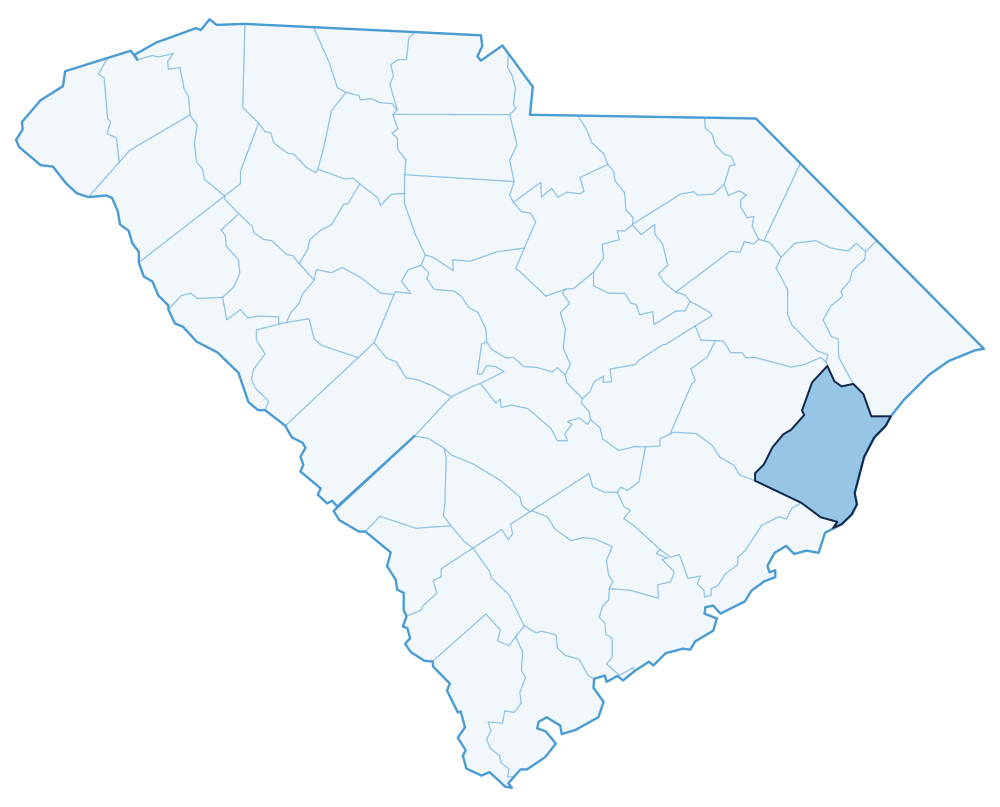
Georgetown County
72 places on the trail: 72 highway markers.
People of Georgetown County in Carolina Quotes
Colonial (pre-contact to 1763)
- 22-54All Saints ParishAnglican services were held on Waccamaw Neck by 1737, with a chapel built on land purchased by Percival Pawley. All Sain...
- 22-17Antipedo Baptist ChurchIn the plan of Georgetown, laid out by 1730, this one acre lot was reserved for Antipedo Baptists by Elisha Screven. A b...
- 22-63Beneventum PlantationThe main house at Beneventum dates to c. 1755. It was likely commissioned by William Fyffe, a surgeon and Scottish emigr...
- 45-07Black Mingo Presbyterian ChurchOne of the earliest Dissenter congregations in South Carolina north of the Santee River was located about two miles sout...
- 22-60Brookgreen PlantationTitle to the land that comprised Brookgreen Plantation is traced to a patent for 48,000 acres granted to Robert Daniell ...
- 22-59Dissenter Meeting House and CemeteryThis is the site of a “Dissenter” meeting house, built ca. 1726 by one of the first Baptist congregations in S.C. outsid...
- 22-02GeorgetownGeorgetown, the third oldest town in the state, was laid out in 1729 by Elisha Screven on land granted to John and Edwar...
- 22-18GeorgetownShips and boats have loaded and unloaded cargo at the Sampit River near Front Street since the founding of Georgetown, c...
- 22-57Hobcaw BaronyIn 1718 the Lords Proprietors granted 12,000 acres on Hobcaw Point, the southern portion of Waccamaw Neck, to John, Lord...
- 22-48John and Mary Perry Cleland HouseThis house, one of Georgetown's earliest, was built ca. 1737 by John and Mary Perry Cleland. Mrs. Cleland inherited the ...
- 22-41Prince George Winyah Parish (1721)Early settlement in this area near the Black River, based primarily on the Indian trade and the production of naval stor...
- 22-09Prince George's Parish Church, WinyahPrince George's Parish, Winyah, was created March 10, 1721, and the parish church was erected on Black River, 1726, at t...
- 22-39Retreat Rice PlantationIn 1711 the Lords Proprietors granted Winyah Barony to Robert Daniel, who sold it to Thomas Smith. By 1787 Retreat had b...
- 22-50The Oaks PlantationThe Oaks Plantation was established on the Santee River in 1705 by a grant from the Lords Proprietors to John Sauseau, a...
- 22-28William ScrevenIn this cemetery is buried William Screven, first pastor of the earliest Baptist church in the South. A native of Englan...
- 22-16Winyah Indigo SocietySpringing from the fervor for indigo, the colony's vital new crop for making blue dye, the Winyah Indigo Society was beg...
Era of American Revolution (1764-1783)
- 22-01Attacks Upon GeorgetownOn January 24, 1781, Capts. Carnes and Rudulph, by orders from Gen. Marion and Col. Lee, surprised the British garrison ...
- 22-44Beth Elohim CemeteryThis cemetery, established ca. 1772, is the second oldest Jewish cemetery in the state and serves a community which has ...
- 22-06Gabriel MarionWhen Capt. John Nelson, who was sent by Gen. Marion in Jan. 1781 to the Sampit Road to reconnoitre, met Capt. Barfield a...
- 22-03HopseweeThomas Lynch, Jr., signer of the Declaration of Independence, was born here, Aug. 5, 1749. He was elected from St. James...
- 22-08LafayetteA lover of liberty, Lafayette left Bordeaux, France, March 26, 1777, "To conquer or perish" in the American cause, and a...
- 22-12Sergeant McDonaldHere Sgt. McDonald bayoneted the fleeing Maj. Gainey, following the defeat of the Tories under Major Gainey by the Ameri...
- 22-07Skirmish at Sampit BridgeIn the early evening about March 20, 1781, the last skirmish between Gen. Marion and Col. Watson was fought at Sampit Br...
South Carolina in the Early Republic (1784-1815)
- 22-05Clifton PlantationPresident George Washington on his southern tour traveled southward over this road, April 27-30, 1791. While in this vic...
- 22-61DeBordieu BeachMany Waccamaw Neck planters summered at the seashore from late May to early November to escape the malarial swamps of th...
- 22-42First Baptist ChurchThis congregation, founded in 1794 and long known as Antipedo Baptist Church, was the first separate Baptist congregatio...
- 22-14Joseph AlstonJoseph Alston (1779-1816) was educated at the College of Charleston and at Princeton. He inherited The Oaks Plantation a...
- 22-15MethodistsWilliam Wayne, nephew of Revolutionary General Anthony Wayne, was converted here by Bishop Francis Asbury on February 24...
- 22-45Robert Stewart HouseThe Robert Stewart House was built between 1740 and 1770 by Robert Stewart (d. 1776), planter and militia captain; it wa...
- 22-24Theodosia Burr AlstonDaughter of Aaron Burr and one of the most learned women of her era; wife of Governor Joseph Alston, who is buried west ...
- 22-13Washington's VisitOn his southern tour in 1791 President George Washington spent the night of April 28 here at Brookgreen Plantation. He w...
Antebellum (1816-1860)
- 22-35All Saints Academy Summer HouseThis house was built between 1838 and 1848 by All Saints Academy for the summer residence of its headmaster. Robert F. W...
- 22-32All Saints Summer Parsonage/ The RectoryThis house, built by 1848, served as the summer parsonage for All Saints Episcopal Church for many years. Evening summer...
- 22-25Birthplace of Jeremiah John SnowChina Grove was the birthplace of the Reverend Jeremiah John Snow (1836-1892), a son of the third James Snow who lived h...
- 22-53Chicora Wood PlantationThis plantation, with its origins in several grants to John Allson in 1732, 1734, and later, was in the hands of his gra...
- 22-46Georgetown County CourthouseThis courthouse, designed by prominent architect and South Carolina native Robert Mills (1781-1855), was built in 1823-2...
- 22-27Hot and Hot Fish ClubEstablished by and comprised of the planters of All Saints Parish, this social club was dedicated to epicurean pursuits....
- 22-29Joseph Blyth Allston House ("Pawley House")This house stands on land owned by R. F. W. Allston, governor of SC 1856-58. His nephew Joseph Blyth Allston obtained th...
- 22-36LaBruce / Lemon HouseThis house, built on 10 acres of beach land by 1858, was owned by the LaBruce family, who were successful rice planters ...
- 22-19Mount Tabor ChurchOrganized as a result of the preaching of Elder James Singleton, the Mount Tabor congregation was constituted October 21...
- 22-34Nesbit / Norburn HouseBy 1842 this house was here on Pawleys Island and was owned by Robert Nesbit (1799-1848). A native of Scotland and a ric...
- 22-31P. C. J. Weston House / Pelican InnPlowden Weston, Lt. Gov. of S.C. 1862-64, obtained land here in 1844 and by 1858 had built this beach residence. The Wes...
- 22-26Pawley's IslandThis island, located about ½ mile east, was used by plantation householders who lived on the seashore from May to Novemb...
- 22-70PlantersvilleEst. c.1835, Plantersville began as a 350-ac. pineland village 6 mi. NE, used by planter families to escape seasonal mal...
- 22-52Prince Frederick's ChapelThe first church on this site, known as Prince Frederick's Chapel, Pee Dee, was built in 1848 on a site donated by the R...
- 22-04Prospect HillOn his tour south to inspect the defenses of the Atlantic coast, President Monroe reached Prospect Hill, Col. Benjamin H...
- 22-38R. F. W. Allston CausewayThis causeway was built between January 1845 and November 1846 by Robert Francis Withers Allston, who owned a summer res...
- 22-30R. F. W. Allston HouseThis summer residence was owned by Robert F. W. Allston (1801-1864) when the state of SC granted the marsh behind it to ...
- 22-56Sampit Methodist ChurchThis church, formally organized in 1839, had its origins in a slave mission begun in 1786 on Gov. Thomas Boone’s plantat...
- 22-47Town ClockThis Greek Revival market and town hall was built in 1842 after a fire destroyed many of the frame buildings on Front St...
- 22-33Ward House / Liberty LodgeThis house, one of the oldest on Pawleys, was reputedly moved here after 1858. It stands on land once owned by area rice...
- 22-11Washington AllstonWashington Allston, "the American Titian," artist and author, was born at Brookgreen, Nov. 5, 1779. He studied in London...
Civil War (1861-1865)
- 22-22Bethel ChurchThis African Methodist Episcopal church was the first separate black church in Georgetown County. It was established by ...
- 22-23General Arthur M. ManigaultVolunteer aide-de-camp to Gen. Beauregard in April 1861, mustered into Confederate service at White's Bridge near here o...
- 22-58Sinking of the USS Harvest MoonIn early 1865 the USS Harvest Moon, a 193-foot, 5-gun side-wheel steamer, was the flagship of Adm. John A. Dahlgren of t...
Reconstruction (1866-1876)
- 22-66James A. BowleyIn the 1870s, this was the home of James Alfred Bowley (c.1844-1891). Born enslaved in Maryland, Bowley was the great ne...
- 22-37Joseph Hayne RaineyThis National Historic Landmark was the family home of Joseph H. Rainey, the first African American elected to the US Ho...
- 22-55Mt. Olive Baptist ChurchThis church was founded in 1866 by Rev. James Smalls, its pastor for many years. The congregation, which built its sanct...
- 22-65St. John A.M.E. ChurchSt. John A.M.E. Church was established in the spring of 1867 with Rev. Saby Green as the first pastor. Early meetings we...
New South (1877-1913)
- 22-62Oak Grove Methodist ChurchBishop Francis Asbury first arrived in Georgetown in Feb. 1785 and would return in 1786, at which time he established a ...
- 22-64Potter's FieldFrom the 1880s to the 1930s the block bordered by Highmarket, Dozier, Duke, and Church streets served as a cemetery for ...
- 22-68St. Stephen A.M.E. ChurchIn 1897, members of Bethel African Methodist Episcopal (AME) Church, led by Rev. Washington P. Carolina (1864-1939), obt...
- 22-43William Doyle Morgan House732 Prince Street was the home of William Doyle Morgan (1853-1938), mayor 1891-1906 and the catalyst for much of Georget...
- 22-20Winyah SchoolsWinyah Indigo School District was created in 1885 to maintain public education in Georgetown. In 1887, the district assu...
World War I and the Interwar Period (1913-1941)
- 22-71Belin Memorial United Methodist ChurchBelin Memorial United Methodist Church (U.M.C.) organized in 1925. The first church building was a frame chapel previous...
- 22-72Florence Williams HospitalThis is the site of the Florence Williams Hospital, opened by its namesake in 1926. Florence Williams (1887-1967) was an...
- 22-49Kaminski HouseThis house, probably built between 1750 and 1800, was for many years the home of Harold Kaminski (1886-1951), Georgetown...
World War II and After (1941-present)
- 22-67Friendly Aid SocietyThe Christian Friendly Aid Society (CFAS), an African American benevolent society, built a lodge here c.1947. The Societ...
- 22-21Howard SchoolAfter purchasing this land January 1, 1866, Georgetown Colored Academy built a school here. By 1908 the old building had...
- 22-69Pawleys Island House of WorshipIn 1946, the Georgetown Ministerial Association resolved to erect a place of Christian worship for summer residents on P...
- 22-51Pleasant Hill SchoolPleasant Hill Consolidated School opened in 1938 as an elementary and high school. It also included a cannery and a home...