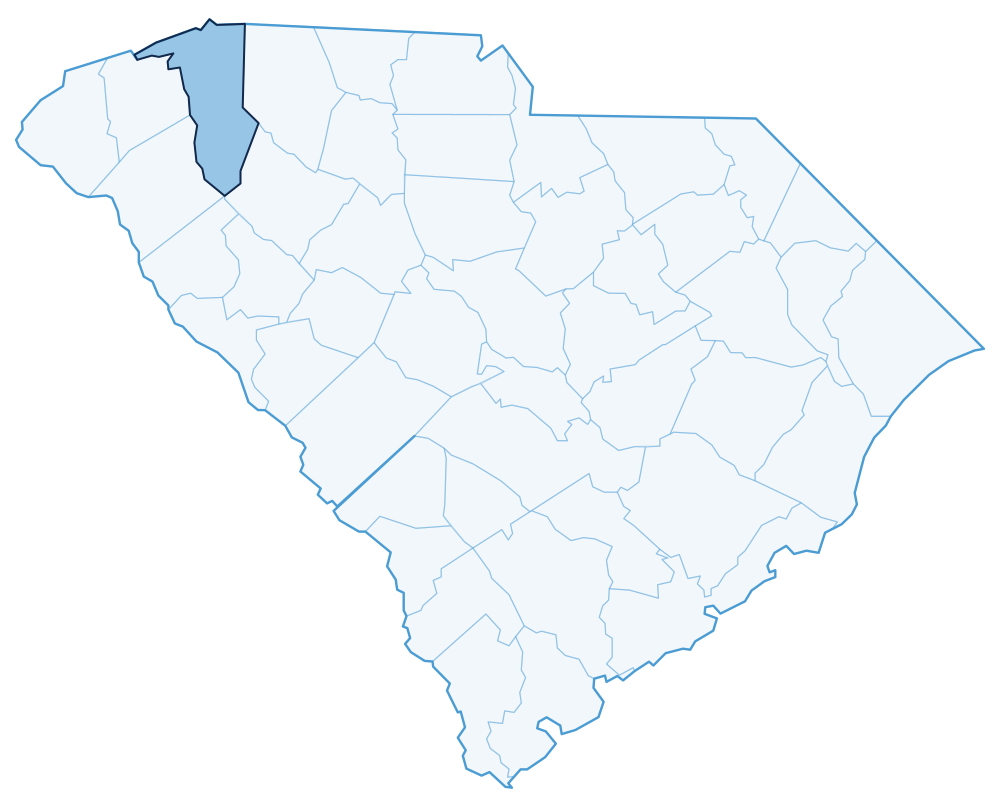
Greenville County
104 places on the trail: 104 highway markers.
People of Greenville County in Carolina Quotes
Colonial (pre-contact to 1763)
Era of American Revolution (1764-1783)
- 23-03Battle of Great Cane BrakeHere along the south side of the creek to Reedy River was fought, Dec. 22, 1775, the Battle of Great Cane Brake between ...
- 23-30Cherokee Boundary (1767)In 1766-67 S.C. & N.C. negotiated with the Cherokee to establish a boundary between Indian land to the west and new sett...
- 23-87Col. John and Jane ThomasJohn Jane Black Thomas emigrated to S.C. c.1755 from Chester Co., PA. John was a local magistrate and militia captain. A...
- 23-33Early White SettlementBy 1768 Indian traders and land speculators Richard Pearis (d. 1794) and Jacob Hite of Virginia acquired large tracts fr...
South Carolina in the Early Republic (1784-1815)
- 23-09"The Poplars"This was approximately the center of the many-acred estate and "seat of hospitality" of Elias Earle, pioneer Greenville ...
- 23-19Fairview ChurchSettlers from the Nazareth area of Spartanburg County founded this Presbyterian church in 1786 on land ceded by the Cher...
- 23-78Fork Shoals Baptist ChurchFork Shoals Baptist Church traces its origins to at least 1789, when Horse Creek Church was organized as a member of the...
- 23-05General Store Alexander McBeth & Co.One of the first stores in this section of the state stood near this spot. Its day book shows that it was in operation i...
- 23-92John H. Goodwin HouseAmong the oldest surviving buildings in Greenville County, the John H. Goodwin House originated as a 2-room log cabin bu...
- 23-16Lebanon ChurchThis United Methodist church was originally located about 1 ¼ miles east and named the Grove. It was visited by Bishop F...
- 23-46MauldinThis area was settled soon after the Revolution, and a community grew up here on the road from Greenville to Laurens. It...
- 23-97Prospect HillThis site was named Prospect Hill by Lemuel J. Alston, an early Greenville resident who acquired the property in 1788. H...
- 23-17Sullivan (Grove) CemeteryThe cemetery located about ½ mile north, marks the site of Grove Church, established prior to 1790, one of the first Met...
- 23-39TigervilleTigerville got its name from early settlers who settled here shortly after the Revolution. They called bobcats they saw ...
- 23-08WhitehallBuilt by Henry Middleton on land bought from Elias Earle in 1813, Whitehall served as Middleton's summer home until 1820...
Antebellum (1816-1860)
- 23-85Berea First Baptist ChurchBerea Baptist Church was officially founded in Dec. 1843, but local tradition holds that the earliest meetings were held...
- 23-13Chick SpringsDr. Burwell Chick opened a resort at these mineral springs in 1840. A spacious hotel and cottages accommodated a large n...
- 23-10Christ Church (Episcopal)Started in 1820 as St. James' Mission, the first church built here in 1825 on land given by Vardry McBee, was consecrate...
- 23-28Cooley's BridgeThe original Cooley’s Bridge, built across the Saluda River in 1835-36 to replace a ferry, stood about 150 yds. above th...
- 23-21Cotton MillsBy 1820 one of the first cotton mills in Greenville County was located at these river shoals. Pelham Manufacturing Co. p...
- 23-103First Presbyterian Church GreenvilleThis church was founded in 1848 by sixteen members. On this corner, a wooden sanctuary was built in 1851 on land donated...
- 23-24Fountain Fox Beattie HouseThis house, built in 1834, first stood a few blocks south on East North St. It was built by Fountain Fox Beattie (1807 1...
- 23-14Furman UniversityEstablished in 1825 by the S. C. Baptist Convention, the Furman Academy and Theological Institution opened at Edgefield,...
- 23-89Gap Creek Baptist ChurchGap Creek Baptist Church was established in 1840 and meetings were held in a log building that stood nearby to Gap Creek...
- 23-81Garrison CemeteryGarrison Cemetery is named for the Garrison family, who were among the first European settlers in the area that became P...
- 23-15Greenville Woman's CollegeEstablished in 1854 by the S. C. Baptist Convention, this institution opened as Greenville Baptist Female College in Feb...
- 23-34Hopkins FarmThis farm has been owned by the Hopkins family since 1834, when John Hopkins (1793-1837) purchased it from William Toney...
- 23-11Joel Roberts Poinsett1779-1851/Born in Charleston, S. C., educated in this country and Great Britain, he travelled widely in Europe and Asia ...
- 23-59McBee ChapelThis church is notable for its unusual octagonal form. It was built by John Adams for workers at the nearby McBee’s Fact...
- 23-44Oakland PlantationThis house was built in 1823 by Dr. Thomas Collins Austin (1790-1883), physician and planter. Austin attended the Medica...
- 23-06Old Fountain InnAccording to tradition an ante-bellum inn with a gushing fountain in the front yard stood near here on the old stage roa...
- 23-12Old Greenville GraveyardAbout 150 feet east of this point are buried some of Greenville's earliest settlers, including Elias Earle (1762-1823), ...
- 23-49Old Stage RoadThe town of Simpsonville grew up around a stagecoach stop nearby operated by Thomas Goldsmith (1788-1868). Goldsmith’s h...
- 23-48SimpsonvilleThis town grew up around a stagecoach stop on the Old Stage Road from Laurens to Greenville. For many years the communit...
- 23-70Simpsonville Municipal CemeteryEstablished in the 1840s as a family cemetery, the two and one-half acre parcel was donated to Simpsonville First Baptis...
- 23-20Site of First Baptist ChurchIn 1825, Wm. Bullein Johnson opened a subscription for a Baptist meetinghouse, which was soon built here. The 120 foot-s...
- 23-101Spring Park InnThe Spring Park Inn is one of the oldest surviving buildings in Travelers Rest. Its eastern section likely dates to c.18...
- 23-91Springwood CemeteryBegun in 1812 as a single grave in a family rose garden, this was a private burial ground before being deeded to the Cit...
- 23-84Standing Spring Baptist ChurchStanding Springs Baptist Church was organized in 1818 as an arm of Fork Shoals Baptist Church. There were ten charter me...
- 23-29Stone's MillThe first grist mill on Big Durbin Creek was built about 1813 for John Bruce (d. 1818), a veteran of the American Revolu...
- 23-01The Old Record Building70 feet south of this point was erected, 1820, "the old record building," designed by Robert Mills (1781-1855), famous C...
Civil War (1861-1865)
Reconstruction (1866-1876)
- 23-72Buncombe Street Methodist ChurchAs early as 1800 Bishop Francis Asbury, founder of American Methodism, rode circuit in the S.C. upcountry, spreading the...
- 23-76Little TexasWilliam E. Earle acquired much of the land now bounded by Beattie Pl., N. Church, Academy, and E. North Sts. at a forecl...
- 23-56Old Pilgrim Baptist ChurchThis church was founded in 1868 by black members of nearby Clear Spring Baptist Church who named their new church Pilgri...
- 23-58Springfield Baptist ChurchThis is the oldest black Baptist congregation in downtown Greenville. It was founded in 1867 by members of Greenville Ba...
- 23-54Suber's MillFour generations of the Suber family have owned and operated a water-powered grist mill on Princess Creek, a branch of t...
New South (1877-1913)
- 23-38BrutontownBrutontown, an historic African-American community, grew up around the intersection of Paris Mountain Rd. and Rutherford...
- 23-25Campbell's Covered BridgeThis bridge, built in 1909, is the last extant covered bridge in S.C. Built by Charles Irwin Willis (1878-1966), it was ...
- 23-53Cedar Grove Baptist ChurchAccording to tradition, this African-American church was organized by Rev. Tom Jones shortly after the Civil War. It hel...
- 23-73Fork Shoals SchoolOriginally associated with Fork Shoals Baptist Church, Fork Shoals School was in operation by 1877. A private Fork Shoal...
- 23-62Fountain Inn CemeteryFountain Inn Cemetery was established c. 1890. Most of the land was deeded to the town by Lafayette Martin, and his son,...
- 23-55Fountain Inn Cotton MillFountain Inn Cotton Mill, which stood here from 1898 to 2002, was first owned and operated by brothers A.J., C.E., R.L.,...
- 23-94Fountain Inn Presbyterian ChurchFourteen charter members organized Fountain Inn Prebsyterian Church in 1889. They met in homes and other temporary sites...
- 23-98Hampton-Pinckney NeighborhoodThe Hampton-Pinckney neighborhood is one of the oldest intact collections of residential buildings in Greenville. Many h...
- 23-18John Broadus WatsonBorn in 1878 about ½ mile SW, Watson was a pioneer in behavioral psychology. He graduated from Furman University, earned...
- 23-36Lickville Presbyterian ChurchThis church, which takes its name from a nearby salt lick, was founded in 1882. Mrs. Ellen C. Woodside (1838-1906) worke...
- 23-96Mattoon Presbyterian ChurchMattoon Presbyterian Church was organized in 1878 by Black members of Washington Street (First) Presbyterian Church. The...
- 23-69Monaghan MillLewis Wardlaw Parker (1865-1916) and Thomas Fleming Parker (1860-1926) established Monaghan Mill in 1900 and named it in...
- 23-47Mush Creek Baptist ChurchThis church, established in 1882, grew out of services held by itinerant Baptist ministers in a nearby log school, encou...
- 23-88Poe MillFrancis Winslow Poe (1853-1926) established the Poe Mill in 1896. The mill was built adjacent to the main line of the So...
- 23-79Poinsett MillOriginally established as the Gates Desk Company in 1893, the mill was renovated and re-chartered as Carolina Cotton Mil...
- 23-105Richland CemeteryRichland Cemetery was established in 1884 by the City of Greenville as a public burial ground for African Americans. It ...
- 23-75Rose Hill CemeteryRose Hill Cemetery was established in 1876 by the Piedmont Manufacturing Co., an early textile mill that began productio...
- 23-50Simpsonville Cotton MillThis mill, opened in 1908, was built after several leading men of Simpsonville asked Edward F. Woodside of the Pelzer Ma...
- 23-32Sterling High SchoolSterling High School stood 3/4 mi. southeast of here and served generations of African Americans in Greenville. Founded ...
- 23-65Taylors First Baptist ChurchTaylors First Baptist Church traces its origins to the years of the American Civil War. The church organized as Chick Sp...
- 23-64Union BleacheryThe Union Bleaching and Finishing Company began operations in 1903 with an initial capacity of 500,000 yards of cloth pe...
- 23-82Wilkins HouseThe Wilkins House was built in 1878 by Greenville builder Jacob Cagle for William Wilkins and his wife Harriett Clevelan...
- 23-23William Preston Few (1867-1940)William Preston Few, prominent Southern educator, was born 1.6 mi. NE in 1867. Few received his Ph.D. from Harvard in 18...
- 23-57Woodside MillWoodside Cotton Mill was the first and largest textile mill owned by brothers John T. (1864-1946), J. David (1871-1945),...
World War I and the Interwar Period (1913-1941)
- 23-86Berea SchoolThe first Berea School built at this location opened in 1916. It was a two-story building with an auditorium on the seco...
- 23-02Camp SevierThis camp, named in honor of John Sevier, Lieutenant Colonel, N. C. Militia, 1777, Col., 1781, Brig. Gen., U. S. P. A., ...
- 23-102Chapman Grove SchoolThis was the site of Chapman Grove School, est. 1921 by J.H. “Prof.” Chapman and other Black residents of lower Greenvil...
- 23-51City HospitalCity Hospital, founded here in 1912 and later renamed Greenville General Hospital, occupied most of the block bounded by...
- 23-74Claussen's BakeryThis two-story trapezoidal plan industrial building is one of two surviving Claussen's bakeries in S.C. Built in 1930, t...
- 23-77Congregation Beth IsraelAround 1910 a group of Jewish families began to meet for Orthodox services in their homes and rented halls around Greenv...
- 23-52Dunean MillDunean Mill, chartered in 1911 and opened in 1912, was one of several textile mills owned by Capt. Ellison Adger Smyth (...
- 23-63Dunean SchoolDunean School, later Dunean Elementary, opened in 1928 with J.H. Anderson as its first principal. Located at the corner ...
- 23-45Fountain Inn Rosenwald SchoolThe Fountain Inn Rosenwald School, also known as the Fountain Inn Colored School, was a complex of several buildings bui...
- 23-67Greenville High SchoolThe cornerstone for this building, the third to house Greenville High School, was laid July 27, 1937 and it was first op...
- 23-99John Street SchoolIn 1921, John Street School for local white children opened at this site. The six-room, one-story brick building fronted...
- 23-83National HighwayThe Bankhead National Hwy. Association was formed in 1916 with the goal of creating a transcontinental highway that woul...
- 23-100Oscar Street SchoolOscar Street School for African Americans opened at this site in 1930. The one-story, brick-veneer school cost $16,500 a...
- 23-40Pepper SchoolPepper School, established in 1914-15, was built on land donated “for the children of my community” by William A. Pepper...
- 23-90Post 3 American LegionIn 1919, fifteen World War I veterans from Greenville established Post 3 of The American Legion. This was the Post’s fir...
- 23-37Sans SouciThis early twentieth century suburb takes its name from Sans Souci, the nearby house and estate of Gov. Benjamin F. Perr...
- 23-66Simpsonville Elementary School) This school was built in 1939 with local funds and with federal funds from the Public Works Administration and the Wor...
- 23-71Simpsonville Methodist ChurchSimpsonville UMC was organized in April 1916 as Simpsonville Methodist Episcopal Church, South. The congregation origina...
- 23-93Southern Bleachery Mill VillageThis is one of more than fifty houses built in 1923-24 for employees of Southern Bleachery, a textile processing plant o...
- 23-31Textile HallTextile Hall, built in 1917 to host the annual Southern Textile Exposition, stood on this side until 1992. The first exp...
- 23-27Working Benevolent Society HospitalThe Working Benevolent Society Hospital, first known as St. Luke Colored Hospital, was a two-story frame building standi...
World War II and After (1941-present)
- 23-43"Shoeless Joe" Jackson HouseThis house, built in 1940, was originally 3 mi. SW at 119 E. Wilburn Ave. It was the last home of Joseph Jefferson Woffo...
- 23-80Bryson High SchoolBryson H.S. opened in 1954, serving African American students in lower Greenville Co. It was one of the many schools con...
- 23-26Donaldson Air Force BaseGreenville Army Air Base opened on this site in 1942 and trained B-25 bomber crews during World War II. Emphasizing air ...
- 23-61Fountain Inn High SchoolFountain Inn High School was built in 1939 and was the town high school until 1957. It remained in use as Fountain Inn E...
- 23-42Greenville County CourthouseThis Beaux Arts building, built in 1916-18, was the fourth Greenville County Courthouse, from 1918 to 1950. It was liste...
- 23-68John L. Plyler HomeThis house was the boyhood home and birthplace of John L. Plyler (1894-1966), a Furman University alumnus and Harvard La...
- 23-104McClaren Medical ShelterMcClaren Medical Shelter, a one-story brick building on a raised basement, was a privately run hospital for African Amer...
- 23-95Potato HouseThe Simpsonville Potato House was built in 1944 for area farmers to store and cure sweet potatoes. In the early 20th cen...
- 23-60Simpsonville LibraryThis Classical Revival building, constructed in 1940, was the Simpsonville Branch of the Greenville County Library until...
- 23-41The Lynching of Willie EarleThe Willie Earle lynching was the last recorded in S.C. and the one of the last in the South. On the night of February 1...